
Mat Ducasse (Skylab) [Interview]
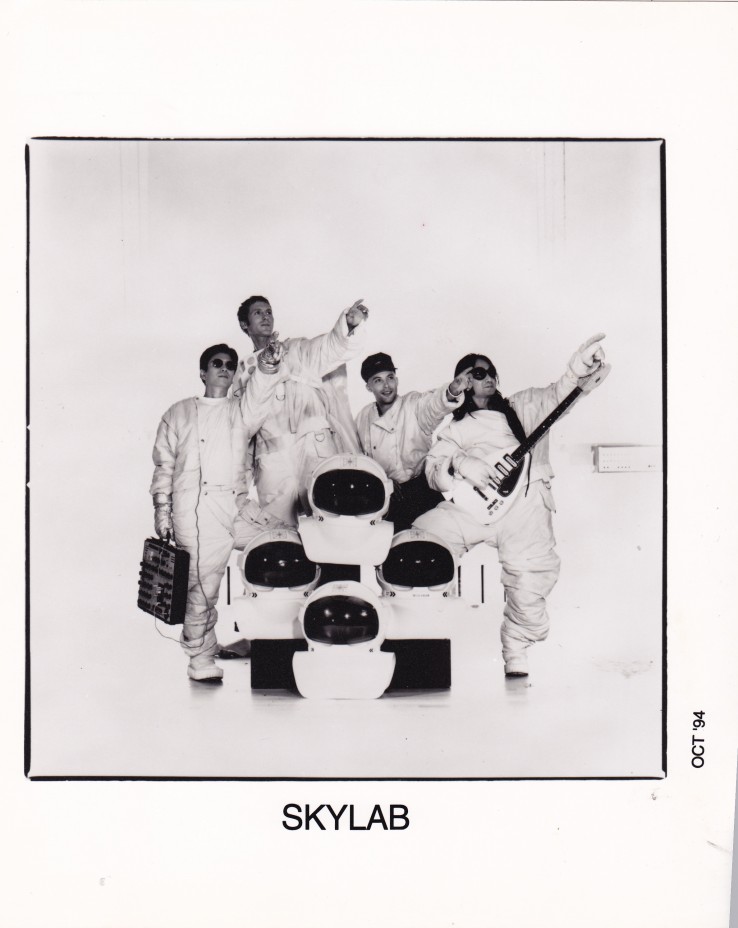
With legendary electronica collective Skylab re-releasing their classic albums #1 and #2: 1999 (Large As Life And Twice As Natural) on June 9, TMMP caught up with core member Mat Ducasse for an incredibly in-depth interview…
Tummy Touch are re-releasing Skylab’s albums #1 (1994) and #2: 1999 (Large As Life And Twice As Natural) (1999) next month. How do you feel thinking back to the years those albums were released?
Hmm. Well, they were certainly interesting times.
In London in 1994 it was all about the raves, the chillouts and so on – or the tail end of that, of which I’m ambivalent. But it was also a time of open-ended creativity. Which is nice. But for me personally it was a time of great upheaval, even chaos, which began pretty soon after the completion of #1. 1999 was produced in a time of real craziness for me. So you know – mixed feelings!
How did Skylab first get together? What was its origin story?
Really the sound, or aspects of it, had been brewing in my mind from an early age, growing up in the psychedelic and space age 60s. But Skylab’s origins date from the early 90s, when me and some friends were inspired by some incredible sound collage mixes Coldcut were putting on the radio with their show Solid Steel.
That, combined with psychedelics, were the basis for a sort of ad-hoc noise and tape room I assembled in my attic – the Skylab – in the north London suburbs. Some intense and hilarious sessions followed.
Another thing that fed into the river was the mass switch over of London record libraries from vinyl to CD which meant a sudden flood of obscure and out-there vinyl into second hand shops, providing a wide range of source material and radical approaches to sound creation. These sessions ran into trouble and I carried on solo, trying to consolidate the experiments.
Then my partner, Sally Gross, was given her own label to manage by the great Elliot Rashman. She hooked me up with Howie B., I made him a tape of stuff I was doing, he loved it, we were given a healthy recording budget, [and] he then introduced me to Toshi and Kudo from the Japanese hip-hop (sort of) [group] Major Force, who had a studio in the Mo Wax offices.
We hit it off straight away, and started the album pretty much from scratch. I think we were very lucky because the project was a leap of faith, we were given free reign, and no one (least of all the band) knew what the result might be, and for this I salute Sally’s conviction and Elliot’s belief – in her and the Skylab project.
What was the Skylab creative process like? How did the process change between #1 and #2?
For #1, it was about a number of people getting in a room and building something together. Usually at the Major Force room in the Mo Wax offices, where the TKO boys had a great selection of toys and gadgets.
Their Echoplex, for example, featured heavily. Start with a sound or a sample or a loop, then someone has an idea what to add; this then would suggest something to follow that, or a treatment of that – then you have a basis which is then taken to a bigger studio for proper recording through a nice Dolby SR system Howie hired in in order to run the tapes at 15 IPS for depth of sound without too much hiss.
These tapes were then mixed and finessed at a top-of-the-range studio with just me and Howie. Some things were from sessions with just me and one of the others, some were built from scratch at Milo – it was very spontaneous and organic and felt very natural even though we were all doing something we’d never really tried before.
1999 was different, although the initial process was similar, and by then Debbie the singer was key to much of it. Me and TKO would get a basic track together, Debbie would freestyle over it, I would then turn this into actual lyrics. We’d re-record and rearrange around this.
Because the label we were on kept turning things down as being too weird, we’d keep re-doing things. Sometimes everything would be done altogether, or lyrics written as [Debbie] sang them – Crocodile #1 was done like this, for example. There was lots of recording in lots of different situations.
How did you feel about the critical/commercial performances of #1 and #2: 1999 the first time around?
Slylab #1 received pretty much unanimous great reviews. It was heartening because it’s really not like anything else before or since and although it emerged from a scene that was labeled trip-hop or ambient it was really outside of those and most reviewers were open to this and responded well to the effort we’d put into it.
The second album was very different in tone and content but again was generally well received, although the record company who carried it collapsed soon after and it got a very limited release – so it’s nice to give it a second chance.
As for sales I have no idea how well either did; the first one obviously did better than the second, and got a more international release (I think 1999 only came out in the UK). I think the second album was probably more of a challenge in that the music has greater variety and contrast and the album is more disruptive in it’s sequencing and contrasts, track to track.
It’s also full of songs, which #1 isn’t, so it falls even further out of genre.
What have you been up to since 1999? What projects are you currently working on?
I had a bit of major music biz trauma that I can’t really talk about, that was concurrent with the making of 1999. That really took it out of me.
The making of 1999 had had its own problems. Toshi and Kudo had gone back to Japan; I sort of made a tactical retreat, lost my confidence and self-belief I guess. I carried on DJing on a small scale, did the Skylab Sound Systems project, did little bits here and there, often with [whoever] was around in Shoreditch in the late 90s/ early 00s. Some sound works for artists, such as re-scoring the songs of Benjamin Britten for birdsong, (I have a piece We Are Stardust in the Venice Bienalle right now). This and that, here and there.
Some stuff [with] William Orbit, some with David Holmes, I even did a stint with Xenomania, the pop crew. I’ve been working lately on an album of covers with a great veteran UK experimental/jazz/soul singer which is a labour of love, working on a great kids’ music project with Debbie the singer from Skylab, been working with my friend Chris Rotter and Jagz Kooner on some things.
I have built up a body [of] work of great variety which is now, prompted by these reissues, beginning to trickle out.
What do you think of the current state of electronic music?
I don’t really know! Not that up on it. I like what Pye Corner Audio or Demdike Stare are doing, I listen to what my friends are up to, but I don’t really listen to much new music. There is just too much to keep abreast of. Too much music!
As for EDM, God save us. What an ugly corruption of something beautiful. Someone dragged me to see Skrillex last year and it was like the Nuremburg rally. I thought it was insulting and hubristic, worse than the worst rock n roll triumphalism.
Which contemporary artists get you excited today?
To be honest these days I barely listen to modern music – seriously, in the way I used to – I was obsessive. The excitement about new releases I felt right through my childhood through glam rock, punk rock, other than my own, partly because I try to avoid current influence, partly because there is so much recycling of things I’m all too familiar [with].
Revive this revive that. I have more fun sifting through things from more inventive eras, finding things I missed the first time around. There is so much of it and it is full of surprises. I also like revisiting that I may have missed the artistry and subtleties of the first time around. Hidden depths of a musical and lyrical nature manifest more clearly through experience.
Oh NOW I see what you mean! I do find things I like occasionally but nothing really EXCITES me in that sense. The last really great record I bought was probably Moodymann’s CD from last year, which is just a great sequence of music beautifully put together.
I’ve always kept in touch with chart music (whether I like it or not) and I have to say the current sate of affairs, this squaresville conservatism, the post-Simon Cowell crassness scares me a little. It’s all so bland and straight and retro, minus the camp that retro needs to make it bearable.
What advice would you give to young artists looking to break out of a given box and discover their own creative voices?
Read Silence by John Cage.
That great Sun Ra quote: “Why don’t you make a mistake and do something right?” or Capt. Beefheart’s Ten Commandments of Guitar Playing, which would work for anything.
If you’re stuck, a good trick I use is to try and copy something I like, then the bit that really goes wrong is the bit you then build on. Or “…what I would I normally do now?” – do the opposite.
Above all listen carefully at all times to the world around you. It’s ALL music.
What’s the best advice you’ve ever received regarding musical creativity?
See above; also of course the punk rock maxim of anyone can do it. Don’t be intimated by musicianship, or seemingly superior beings, or smoke and mirrors.
What’s on your bucket list?
My dotage, in a cottage in the Lake District, laudanum reveries while the storm rages without. One last Skylab album to complete the trilogy.
Links
Check out TMMP’s double review of #1 and #2: 1999 (Large As Life And Twice As Natural) here.
Follow TMMP on Twitter for more from the world of world-class music! If you’re a regular reader, thanks for the support! Don’t stop, and keep going!